Read this as a reflective guide. Keep what helps you observe your experience more clearly, and leave what does not fit.
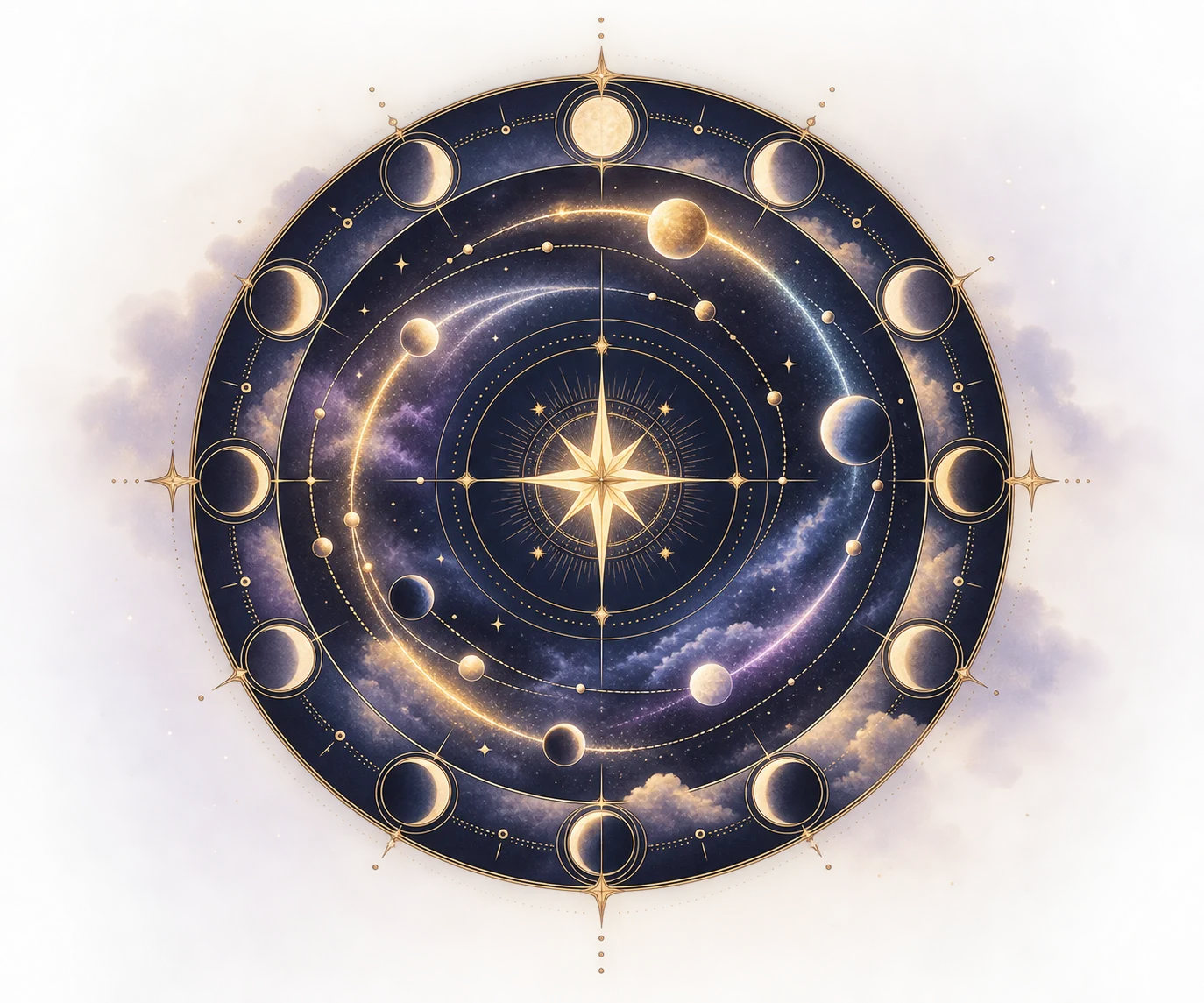
The Moon's phases are visible changes in illumination created by the changing geometry of the Sun, Earth and Moon. The Moon does not produce its own visible light; sunlight illuminates the portion we see from Earth. A complete phase cycle—from one New Moon to the next—lasts about 29.5 days.
Astrology uses this observable cycle as a symbolic framework for beginnings, development, culmination and release. The astronomical phase is calculated; the interpretive meaning belongs to an astrological tradition. Keeping those layers separate makes the guidance clearer.
New Moon
At New Moon, the Sun and Moon share approximately the same ecliptic longitude. The Moon is close to the Sun in the sky and is usually not visible from Earth.
Astrologically, the New Moon is often used to frame initiation, intention and the start of a cycle. That does not mean every New Moon guarantees a new event. A useful practice is to choose a modest area of attention and define one action that can be reviewed as the cycle develops.
Waxing phases
After the New Moon, the visible illuminated portion grows. The waxing crescent is commonly associated with early effort and experimentation. The first quarter occurs when the Sun and Moon are approximately 90 degrees apart and is often linked with decisions, friction and action.
The waxing gibbous phase follows as the Moon moves toward fullness. Symbolically, it can support refinement: checking what is working, adjusting the method and preparing for greater visibility.
Full Moon
At Full Moon, the Sun and Moon are approximately opposite in zodiac longitude. The lunar disk appears fully illuminated from Earth.
Astrological writing often describes the Full Moon as culmination, visibility or heightened awareness. Avoid treating it as a universal emotional crisis. A chart-specific interpretation requires the lunation's measured relationship to eligible natal positions. Without that comparison, the phase can still serve as a general review point.
Waning phases
After fullness, the visible illumination decreases. The last quarter again places the Sun and Moon about 90 degrees apart, but now within the releasing half of the cycle. It is commonly associated with reassessment, correction and deciding what no longer deserves continued effort.
The waning crescent, sometimes called the balsamic phase, precedes the next New Moon. It can be used for closure, rest and making space. This is a reflective structure, not an instruction to stop necessary work or make major decisions solely because of a phase.
Zodiac sign and house context
The zodiac sign of a lunation describes the style of themes traditionally associated with that phase. A New Moon in an earth sign may be framed around practical foundations; one in an air sign may foreground ideas, dialogue or perspective.
House placement requires an eligible timed natal chart. If the birth time is unknown, a report should not claim that a New Moon falls in a particular natal house. It can discuss the phase and stable natal aspects without inventing a house framework.
Natal contacts
A lunation becomes more personal when it forms a calculated aspect to a natal planet or eligible angle. The interpretation should identify:
- the lunation longitude and timestamp;
- the natal fact being contacted;
- aspect type and orb;
- birth-time eligibility;
- the supported meaning of that specific configuration.
A Full Moon near natal Mercury may make communication, information or a decision more visible. Near natal Saturn, it may bring attention to commitments, limits or responsibility. These are different configurations and should not receive interchangeable advice.
Eclipses are not every New or Full Moon
Solar eclipses occur at New Moon and lunar eclipses at Full Moon, but only when the alignment occurs near the Moon's orbital nodes. Eclipse interpretation should be based on a verified eclipse event, not dramatic language added to an ordinary phase.
No phase or eclipse proves that a specific external event will occur. Avoid claims of guaranteed endings, sudden wealth, destined meetings or unavoidable danger.
A practical lunar review
You can use the cycle without treating it as a command:
- At the New Moon, name one area of attention.
- At first quarter, note the first real obstacle or decision.
- At the Full Moon, review what has become visible.
- At last quarter, adjust or release one part that is not working.
Keep ordinary evidence in charge. The value of the cycle is its regular rhythm of intention, observation and review—not a promise that the sky will make the decision for you.
A note on scope
Astrology content is provided for reflection and general information. It does not replace medical, legal, financial, or mental-health advice.