Read this as a reflective guide. Keep what helps you observe your experience more clearly, and leave what does not fit.
Choosing exact, approximate, or unknown for a birth time is not a test of how “good” your chart will be. It tells the calculator which parts of the chart can be treated as dependable and which parts need a wider margin of uncertainty.
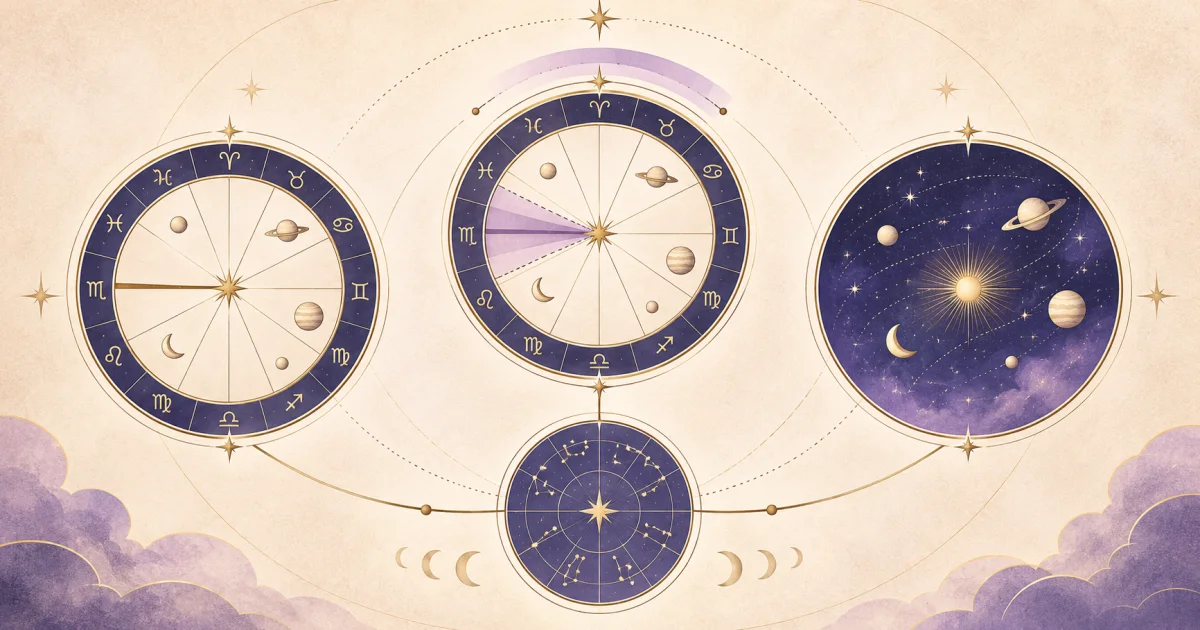
An exact time can support time-sensitive features such as the Ascendant and houses. An approximate time may support a range of possible angles and house placements, provided the uncertainty is shown. An unknown time still supports date-based planetary information, but it should not be turned into a timed chart by silently assuming noon.
The honest choice produces the most useful reading because it prevents false precision. Here is how to select the right status and what to expect from each one.
Birth-time status is an evidence label
A chart calculation begins with a date, time and place. The date establishes the calendar day. The place helps determine the local time zone and, when a time is available, the orientation of the sky from that location. The time is especially important for features tied to the horizon and meridian.
That makes the birth-time field different from an ordinary form field. Entering a precise-looking time does not make it accurate. A remembered time such as “around seven in the evening” should not be recorded as exactly 7:00 PM merely because the form accepts it.
The three statuses let the reading preserve that distinction:
- Exact: supported by a reliable record or a confidently documented time.
- Approximate: remembered or estimated, with a meaningful uncertainty range.
- Unknown: no dependable time is available.
None of these choices describes the person. They describe the available evidence.
When to choose exact
Choose exact when the time comes from a dependable source such as a birth record, hospital record, official family document or another contemporaneous record you trust. A clearly remembered time may also be usable, but it is worth distinguishing a precise memory from a rounded family recollection.
With an exact time, a chart can calculate:
- the Ascendant and other chart angles;
- house cusps and planetary house placements;
- the chart ruler derived from the Ascendant;
- relationships between planets and time-sensitive angles;
- timing techniques that explicitly depend on those calculated features.
Exact does not mean that every interpretation becomes certain. It means the astronomical inputs are precise enough to calculate the timed framework. Interpretation remains a traditional symbolic practice, and real-life decisions still need real-world evidence.
If two documents show different times, do not choose the more convenient one. Record the discrepancy and use approximate until it is resolved.
When to choose approximate
Choose approximate when the time is remembered as a range or rounded estimate: “between 6:30 and 7:00,” “just before sunrise,” “around lunchtime,” or “about 9 PM.” Include the narrowest range that the source genuinely supports.
An approximate chart should not hide that range. A responsible calculation can compare the beginning and end of the interval to see what remains stable. For example, some planetary positions may remain effectively unchanged while the Ascendant, angles or house placements move enough to alter the interpretation.
The useful question is not “Can the approximate chart be used?” It is:
Which findings remain supported throughout the stated time window?
Stable findings can be discussed with more confidence. Time-sensitive findings should be labelled as possibilities, narrowed, or omitted. If two possible Ascendants fall within the interval, a report should not select one solely because its description feels more familiar.
Approximate time is often more informative than unknown time, but only when the uncertainty is carried through the calculation and the writing.
When to choose unknown
Choose unknown when there is no trustworthy time, when family memories conflict too widely, or when the only available time was created by an earlier website or astrologer without a source.
A date-only chart can still calculate useful information. Depending on the date and the planet’s movement, it may support:
- stable planetary sign positions;
- planetary relationships that remain valid across the day;
- date-based transit comparisons;
- broad themes that do not depend on houses or angles.
The Moon moves more quickly than the other commonly used planets, so its exact degree—and sometimes its sign—may need special handling. A date-only calculation can check the Moon’s range across the day and disclose whether one conclusion or more than one possibility is supported.
What an unknown-time chart should not claim is equally important. It should not invent an Ascendant, Midheaven, houses or a chart ruler. Selecting noon as a technical reference may be useful for calculating date-based positions, but noon must not be presented as the person’s birth time.
What changes in the reading?
The main difference is the level of eligible detail, not whether the reading has value.
With an exact time
The reading can use the complete timed structure. It can connect planets with houses, examine angles and describe themes tied to specific life areas. Even here, good writing should focus on a small number of relevant combinations rather than turning every placement into a prediction.
With an approximate time
The reading should separate stable findings from time-sensitive possibilities. It may say that a theme remains consistent across the interval while a house emphasis changes. This creates a layered reading rather than a falsely exact one.
With an unknown time
The reading should use only stable date-based facts. It can still explore planetary patterns, communication style, relationship dynamics or broad timing periods when the underlying calculations support them. It will be less specific about houses, angles and techniques that depend on birth time.
A practical example
Imagine three people born on the same date and in the same city.
The first has a recorded time. Their chart supports the Ascendant, houses and timed angles. The second knows they were born between 8:00 and 9:00 PM. Their calculation compares that hour and retains only the findings that survive the interval. The third has no time. Their chart uses the stable planetary picture for the date and omits houses.
They do not receive three different standards of care. They receive three different evidence boundaries.
That is preferable to giving all three people the same noon chart and allowing the design to imply equal precision.
How to choose the status on DailyAstroAI
Before using the birth chart calculator, ask:
- Where did this time come from? A document, a direct family memory, a rounded recollection or an earlier unsourced chart?
- Is the minute meaningful? “7:12” copied from a record is different from converting “around seven” into 7:12.
- Could I state a reasonable range? If yes, approximate is usually more honest than exact.
- Do sources conflict? If they do, use approximate or unknown until the difference can be resolved.
You can update a saved record later if better information becomes available. There is no benefit in making the initial input look more precise than it is.
How to use the resulting reading
Treat supported chart themes as prompts for observation. Compare them with your lived experience, current circumstances and choices. If a time-sensitive conclusion is marked uncertain, do not build an important decision around it.
For a fuller explanation of why angles and houses depend on time, read Why Birth-Time Accuracy Changes an Astrology Chart. For the order in which chart factors are combined, see How to Read a Western Tropical Birth Chart.
Frequently asked questions
Is a birth certificate time always exact?
It is usually a stronger source than a later memory, but records can still be rounded, transcribed or corrected. Use the best available source and keep any known limitation attached to the record.
Should I use 12:00 PM when my birth time is unknown?
Not as a claimed birth time. A calculation may use a reference instant internally to examine date-based planetary positions, but it should exclude time-dependent chart features and clearly label the record as unknown.
Can an approximate time be improved later?
Yes. A better document may narrow or resolve the range. Some astrologers also offer rectification, but that is an interpretive process rather than a replacement for documentary evidence and should be described with appropriate caution.
The best birth-time choice is the one that tells the truth about what you know. Clear uncertainty does not weaken a reading; it keeps the useful parts anchored to evidence.
A note on scope
Astrology content is provided for reflection and general information. It does not replace medical, legal, financial, or mental-health advice.